
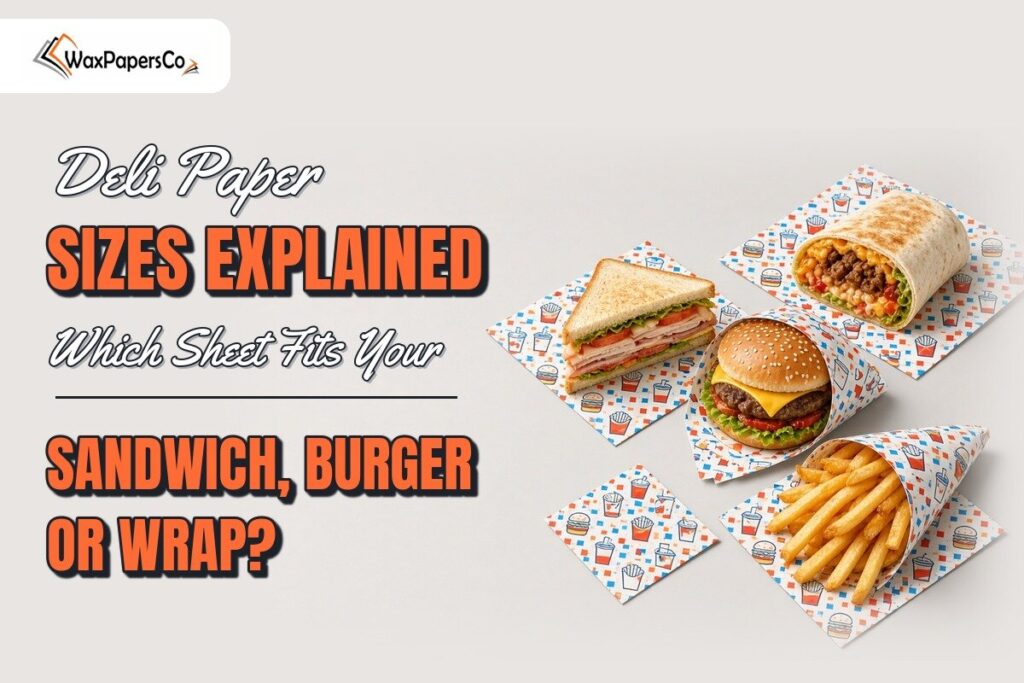
Quick answer: Most food businesses use 12×12 deli paper, because it wraps regular burgers, deli sandwiches and small wraps and also lines a standard burger basket. Use 6×6 for sliders and pastries, 8×8 for breakfast sandwiches, 10×10 for standard burgers and half sandwiches, and 15×15 for footlong subs and burritos.
Most people who order deli paper for the first time pick a size by guessing. I get it. A 12×12 sheet sounds about right for most things, so that’s what goes in the cart. Then the first lunch rush hits and someone on the line is folding a footlong sub into a sheet that barely closes, or wasting half a sheet on a slider.
Getting the size right saves you money on every box. It also makes your food look better when it lands on the table, and it keeps grease off your customers’ hands. This guide walks through the common deli paper sizes, what each one is good for, and how to pick the right sheet for sandwiches, burgers and wraps.
If you’re new to the material itself, our post on what deli paper is covers the basics. Here we’ll stick to size.
Why the sheet size matters more than you’d think
A sheet that’s too small tears at the corners or leaves a gap where sauce leaks out. A sheet that’s too big gets bunched up, looks sloppy, and you pay for paper that ends up in the trash.
There’s a cost side too. A 12×12 sheet is 144 square inches of paper, while a 10×10 is 100. That means a 12×12 uses 44% more paper. If a 10×10 does the job for your main item, that extra 44% is money going straight into the trash on every sheet. Shops that dial in their size usually see the difference on their next reorder.
And then there’s the look. A burger wrapped tight in a sheet with your logo facing up tells people you care about the small stuff. A crumpled wrap with the print folded inside doesn’t.
Deli paper size chart
Deli sheets usually come as squares, but rectangles are common too. In our online design tool you’ll find a long list of sheet sizes, from 4” x 4” up to 20” x 13”, including rectangles, and our team can cut 15×15 sheets as well. Here are the sizes most food businesses end up using:
| Sheet size | Best for | Notes |
|---|---|---|
| 6” x 6” | Sliders, cookies, pastries, small snacks | Good as a hand wrap or a basket liner for small portions |
| 8” x 8” | Small burgers, breakfast sandwiches, bagels | Popular with cafes and breakfast spots |
| 10” x 10” | Standard burgers, half subs, regular sandwiches | A safe all-rounder for many menus |
| 12” x 12” | Large burgers, deli sandwiches, wraps, basket lining | The most ordered size in many delis |
| 15” x 15” | Footlong subs, big wraps, burritos, combo baskets | Use when food is long or very full |
| Rectangles (12” x 8”, 13” x 10”, 14” x 12” and others) | Hoagies, paninis, tray liners | Handy when your food is long, not round |
We also have ready product pages for 6×6 deli paper, 8×8 deli paper, 10×10 deli paper and 12×12 deli paper, if you already know what you need.
How to measure your food for the right sheet
You don’t need anything fancy. Grab a ruler and the item you sell the most.
- Measure the widest point of the food. For a burger that’s the bun. For a sub it’s the length.
- Measure the height. A tall stacked burger needs more paper than a flat smash patty.
- Add the height twice to the width, then add two or three inches for the fold.
So a 4-inch bun that stands 2.5 inches tall needs about 4 + 5 + 2, which is roughly 11 inches. A 10×10 can work if you wrap it tight. A 12×12 gives you room to spare. That works because most deli wraps are folded corner to corner, and a 10×10 sheet measures about 14 inches across the diagonal.
A quick test I’d always suggest: order a small batch of two sizes and let your line cooks try both during a real shift. They’ll tell you in about ten minutes which one they prefer.
Which deli paper size fits a sandwich?
Most sandwiches fit a 10×10 or 12×12 deli sheet, breakfast sandwiches fit 8×8, and footlong subs need 15×15 or a long rectangle. Sandwiches vary more than anything else on a menu, so start with the bread.
Square sandwiches on sliced bread
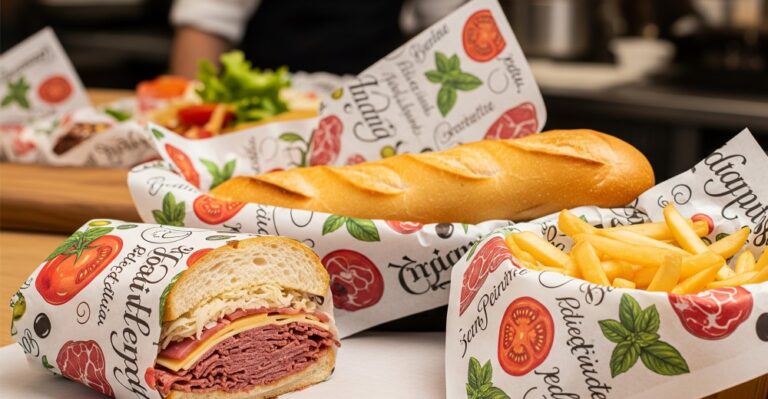
A classic turkey and swiss on sliced bread is around 4.5 to 5 inches across. A 10×10 or 12×12 sheet wraps it well. If you cut it in half and wrap both halves together, go with 12×12 so the paper still closes over the cut edge.
Subs, hoagies and long rolls
A 6-inch sub fits in a 12×12 sheet when you wrap it diagonally. For a footlong, you’ll want 15×15 or a long rectangle. Wrapping a footlong in 12×12 almost always leaves an end open, and that’s where the oil and dressing come out.
Breakfast sandwiches and bagels
These are smaller and rounder. An 8×8 sheet is usually enough for an egg and cheese on an English muffin. Bagel shops tend to like 10×10 because a loaded bagel with cream cheese gets messy. We also make custom bagel paper if you want something made just for that.
For shops that sell mostly sandwiches, take a look at our custom sandwich paper. It’s the same idea, sized and printed for sandwich wrapping.
Which deli paper size fits a burger?
Most single burgers fit a 10×10 or 12×12 sheet, sliders fit 6×6, and loaded doubles need 12×12 or larger. Burgers are easier than sandwiches because they’re round and fairly standard.
Sliders
A slider bun is around 2.5 to 3 inches wide. A 6×6 sheet wraps one neatly. Some places use 8×8 so there’s a bit of extra paper to hold.
Regular burgers
Most single patty burgers sit on a 4 to 4.5 inch bun. Go with 10×10 if you wrap it fully or 12×12 if you like a looser wrap with room to fold back while eating. A lot of burger joints use 12×12 because one size covers singles and doubles.
Double stacks and loaded burgers
Once you add a second patty, bacon, onion rings or anything tall, the 12×12 sheet is the minimum. If you also want the paper to line a basket under the fries, a 15×15 sheet does both jobs.
Our custom burger wrapping paper page has all the size options, and if your burgers ship in boxes, custom burger boxes pair well with a printed liner.
Which deli paper size fits a wrap or burrito?
A wrap made with a 10-inch tortilla needs at least a 12×12 sheet, and burritos made with 12 or 14 inch tortillas need 15×15. Wraps are where people most often go too small. A 10-inch tortilla rolled up is about 7 to 8 inches long and 2.5 to 3 inches thick. That needs a 12×12 at the very least.
For burritos made with 12 or 14 inch tortillas, go to 15×15. You’ll want enough paper to fold the bottom up and roll the sides so it holds together when someone peels it back to eat.
Some food trucks skip the full sheet and use a sleeve instead. Our custom burrito sleeves hold the wrap from the bottom so people can eat it on the go. Taco places can also check our custom taco wrapping paper.
Using deli sheets as basket and tray liners
Deli paper isn’t only for wrapping. Lots of restaurants lay a sheet in a basket or tray and set the food right on top.
For a standard plastic burger basket, 12×12 is the usual pick. It leaves the corners hanging over the edge, which looks nice and catches drips. For larger trays, 15×15 or a 14×12 rectangle works better. If lining is your main use, take a look at our food basket liners.
Square or rectangle: which should you choose?
Squares are flexible. You can wrap on the diagonal, which is the fastest way to close a sandwich, and you don’t need to think about which way the sheet goes.
Rectangles save paper on long items. A sub wrapped in a 14×12 rectangle uses less paper than one wrapped in a 15×15 square. The downside is that staff have to line it up the right way each time, which slows things down a little during rush hour.
If you have one main menu item, pick the shape that suits it. If your menu is mixed, squares are usually easier.
Does paper weight change the size you need?
Sort of. Heavier paper is stiffer, so it doesn’t fold as tight around small items. If you’re wrapping sliders in a heavier sheet, size up a little. Thin, light deli paper folds easily, so you can often use a slightly smaller sheet.
Greasy foods are another thing to think about. For fried chicken sandwiches or anything dripping with sauce, look at greaseproof paper or hot paper, which is built to hold heat and oil.
When a custom size makes sense
Standard sizes cover most menus. But some shops have a signature item that just doesn’t fit any of them, like an extra long hoagie or a square flatbread.
In that case, tell us your size and we’ll cut sheets to match. It’s how many of our deli customers got their perfect fit. Since most sizes have no minimum order, you can test a custom size in a small run before you commit to a big one.
You can upload your logo and try a layout with our online design tool, or send your details through the quote form and our team will help you choose.
Quick size cheat sheet
- Sliders and pastries: 6×6
- Breakfast sandwiches, small burgers: 8×8
- Regular burgers, half sandwiches: 10×10
- Big burgers, deli sandwiches, wraps, basket liners: 12×12
- Footlong subs, burritos, combo baskets: 15×15
- Long rolls or trays: a rectangle like 12×8, 13×10 or 14×12
Frequently asked questions
What is the most common deli paper size?
12×12 is the size we see ordered most. It wraps a regular burger, a deli sandwich or a small wrap, and it fits most burger baskets as a liner.
What size deli paper do I need for a burger?
For a standard single patty burger, 10×10 or 12×12 works. Sliders fit in 6×6 or 8×8. Double or loaded burgers need 12×12 or bigger.
Can I wrap a footlong sub in 12×12 paper?
You can try, but the ends usually stay open. A 15×15 square or a long rectangle closes it fully.
Do you make custom deli paper sizes?
Yes. Along with standard squares, Wax Papers Co cuts rectangles and custom sizes to fit your menu, with no minimum on most sizes.
Is deli paper safe for hot food?
Deli paper is made to hold food directly, including hot sandwiches. For very oily or very hot items, greaseproof or hot paper holds up better.
Should I choose square or rectangle sheets?
Squares are faster and work for most items. Rectangles save paper on long foods like subs and paninis.
Find the right sheet for your menu
Picking a deli paper size comes down to what you sell most and how you like to wrap it. Measure your top item, test two sizes, and go with the one your team likes using.
When you’re ready, browse our custom deli paper options or request a free quote. Tell us what’s on your menu and we’ll help you pick a size that fits, with your logo printed on every sheet.